



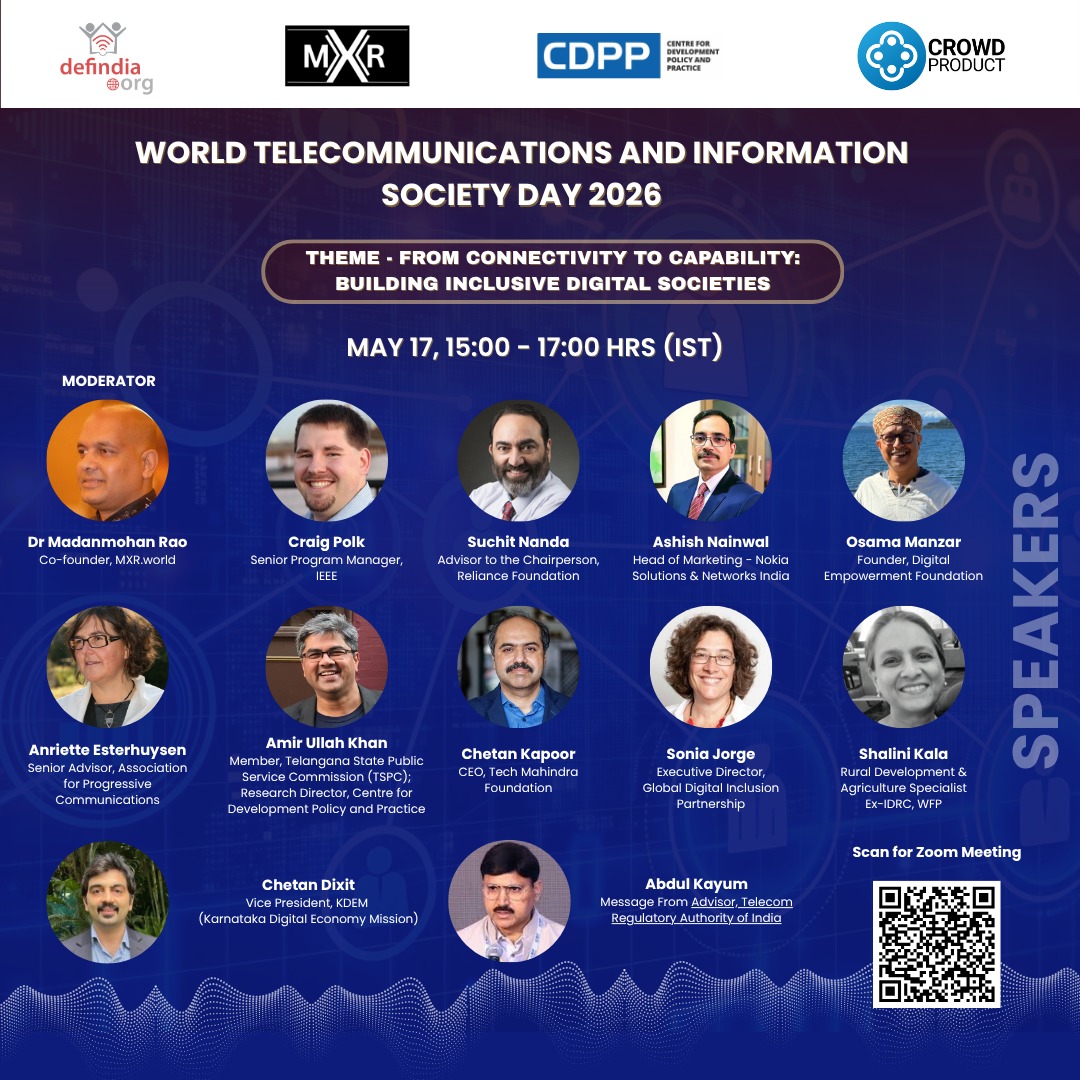
As part of the observance of World Telecommunication and Information Society Day (WTISD) 2026, a multi-stakeholder dialogue is being convened to reflect on the evolving journey of telecommunications and the internet, and their profound impact on societies across the world. At a time when digital technologies increasingly shape economies, governance systems, education, healthcare, livelihoods, and everyday social interactions, the dialogue seeks to critically examine whether the digital revolution has truly led to greater inclusion and empowerment, or whether it has deepened existing inequalities in new forms.
Anchored around the theme “From Connectivity to Capability: Building Inclusive Digital Societies,” the session moves beyond the conventional understanding of digital inclusion as mere internet access. While the expansion of connectivity infrastructure over the past decades has undoubtedly transformed communication and information exchange globally, the conversation recognizes that access alone does not automatically translate into participation, opportunity, or empowerment.
The dialogue aims to explore how societies can move from ensuring connectivity to enabling meaningful digital capabilities, where individuals and communities are not only connected to digital networks, but are also able to effectively use technology to access opportunities, exercise rights, participate in decision-making, and improve their socio-economic conditions.
Central to the discussion is a critical question:
Have digital technologies made our societies more inclusive, or more unequal?
This question gains increasing relevance in the context of widening digital divides shaped by geography, gender, class, language, disability, literacy, and access to resources. Even as digital ecosystems continue to expand rapidly through AI, data-driven governance, digital finance, and platform economies, millions remain excluded from the benefits of technological transformation due to structural and systemic barriers.
The session seeks to unpack these layered realities by bringing together diverse voices from technology, policy, research, philanthropy, civil society, and grassroots community engagement. The dialogue will create space for reflection on how digital infrastructures are being built, who benefits from them, who remains excluded, and what inclusive digital futures should look like in practice.
The session also acknowledges that digital inclusion is no longer solely a technological issue; it is deeply connected to questions of justice, representation, sustainability, and democratic participation. As societies increasingly depend on digital systems, ensuring that technology serves communities equitably becomes both a developmental and ethical imperative.
Moderated by Dr. Madanmohan Rao, the dialogue will bring together an eminent and diverse panel of speakers, including Craig Polk, Suchit Nanda, Ashish Nainwal, Osama Manzar, Anriette Esterhuysen, Amir Ullah Khan, Chetan Kapoor, Sonia Jorge, Shalini Kala, and Chetan Dixit, along with a special message from Abdul Kayum.
By fostering dialogue across sectors and perspectives, the session hopes to contribute to broader conversations on building digital societies that are not only connected, but also inclusive, participatory, and capable of enabling dignity, opportunity, and agency for all.