


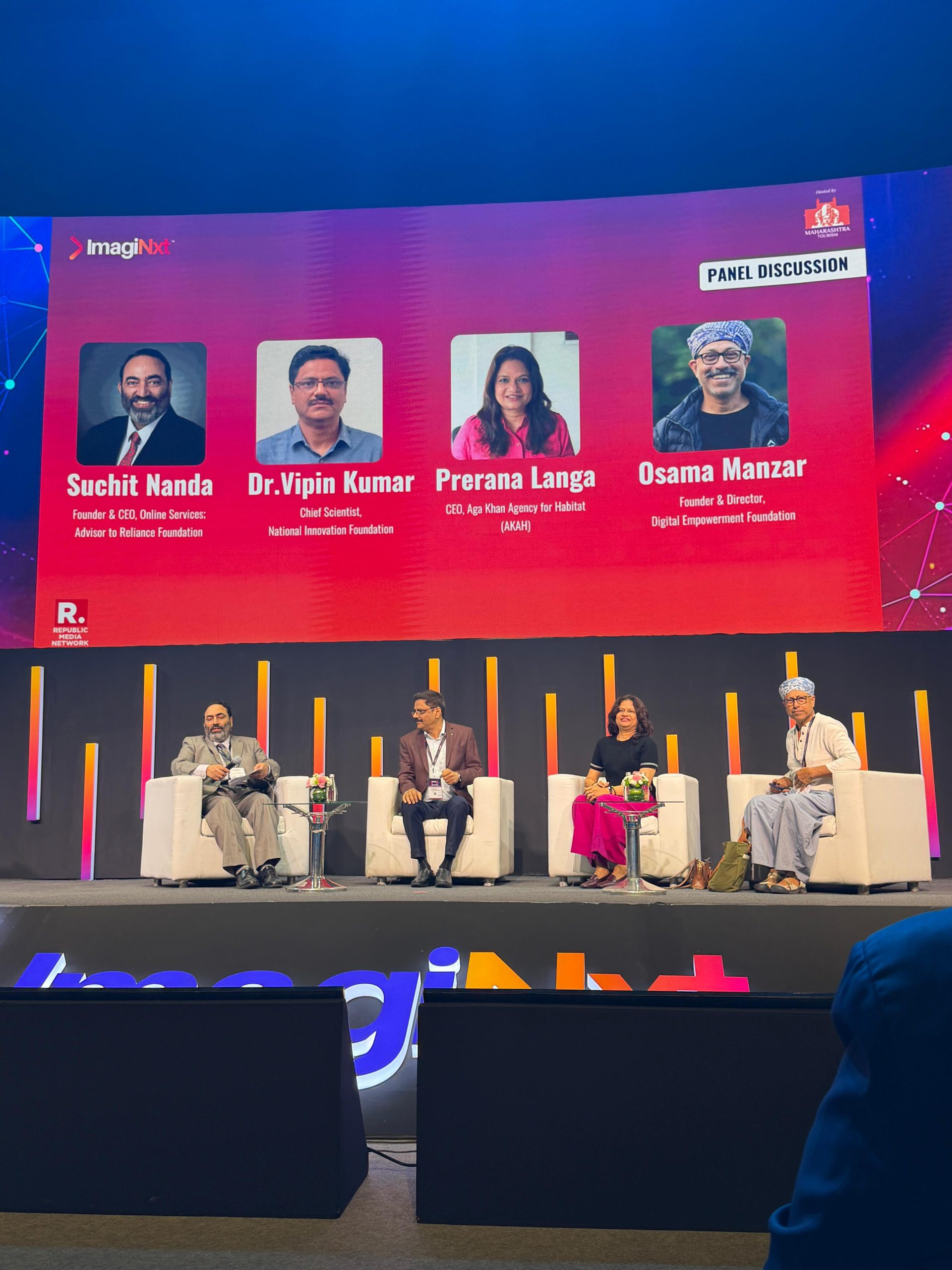
@ Panel Discussion at ImagiNXT
Last weekend, at the ImagiNxt summit in Mumbai, I sat in the audience listening to a panel discussion titled “The other India is already innovating” where DEF Founder-Director Osama Manzar, as one of the panellists, joined the conversation on grassroots innovation. Listening to the panellists talk about solutions born not from funding rounds or R&D labs, but from necessity, resourcefulness, and an intimate knowledge of local problems, I realised we don’t have a shortage of innovation in this country. We just don’t consider them “attractive” enough to back.
Possibly an oversimplification, but somewhere in a village, a farmer already knows tomorrow’s weather. Not from an app or a meteorological report but from the way the wind moves, the way cattle behave, the way the sky looks at dusk. He doesn’t call it innovation. It’s just life. Meanwhile, in cities, entrepreneurs are excitedly “innovating” zero-energy refrigeration, cool roof techniques, organic food value chains and conscious living apps. What we sometimes forget is that some of these aren’t new ideas being designed in urban labs and handed down to communities. They are simply ways of living that some rural communities have held on to, and that cities are now trying to find their way back to.
So when urban India calls this innovation, and calls rural India’s version jugaad, are we measuring ingenuity by access, not ability? Jugaad (largely translated for English speaking audiences as ‘frugal innovation’) is funnily often dismissed as improvisation that falls short of “real” innovation. One lacking science, validation, scalability. But that judgement comes from a position of choice. When resources are scarce and options are few, jugaad is the innovation. The difference between the two words often has less to do with the solution, and more to do with the socioeconomic conditions and geographic locations in which it was born. Cities rediscovering what some communities never left rarely get called jugaad. That asymmetry is interesting.
It also helps to expand what we mean by innovation itself. It isn’t always a product or a service. It isn’t always digital. And sometimes it’s a process — a better way of doing something that already exists, shaped by the constraints and knowledge of a specific place. By that measure, rural communities across India have been innovating for generations. The question is whether we’ve been paying attention, or just waiting for it to look like something we recognise.
And that’s a gap worth closing. Not by bringing urban solutions to rural communities, but by investing in their capacity to build: through their own digital platforms, advanced skills, maker tools, and spaces to experiment. Imagine a generation of young people in villages who can not only identify the problems they live with, but design and code solutions uniquely tailored for their communities! That’s not a distant idea. It’s just one we haven’t invested in yet.
Udita Chaturvedi is a strategic communications and advocacy professional with 12+ years of experience across international development, digital innovation, and social impact. As Coordinator – Digital Innovation Ecosystems at the International Telecommunication Union, she leads global digital transformation initiatives, research collaborations, and stakeholder engagement efforts with governments and development partners.
Written by Udita Chaturvedi at: https://medium.com/@uditachaturvedi/the-innovation-we-often-walk-past-09ea45b2ca31