

From satellite imagery to predictive models feeding into policy, algorithms are increasingly being trusted to flag where malnutrition may strike next. But data alone cannot tell us who goes hungry, or why.
That tension sat at the heart of the second ACTION Webinar, which brought together Romita Ghosh, Founder of MAAP AI, and Prof. Bartlomiej (Bartek) Papiez, Group Lead at the Big Data Institute, University of Oxford, in a conversation moderated by Monica Shrivastava. Both speakers cautioned against treating AI as a quick fix. Without correctly identifying the real problem, they argued, even the smartest tool is unlikely to work. Instead of building AI for everything, everywhere, we should first look at what already exists and adapt it to local environments and populations. Monica’s moderation steered the discussion toward the questions that matter most: where these tools meet ground realities, and how they can inform equitable action. Above all, it is human decisions that determine whether any intervention succeeds.
The Asia Collective on Women’s Nutrition (ACTION) webinar series is a collaborative effort of UNICEF, Population Council Consulting, and Digital Empowerment Foundation’s Just AI Initiative. Together, the partners are creating a space for dialogue, learning, and collective reflection on the intersection of AI, nutrition, and women’s health in the Asia-Pacific region. Stay tuned for the next edition.
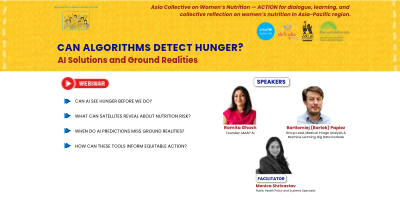
Photo Gallery
