


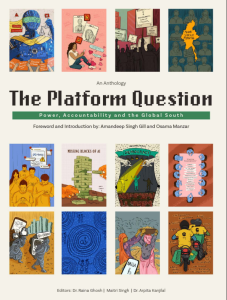
 “The Platform Question” is an anthology that emerges from a global collaboration among scholars, practitioners, and activists who come together to critically reflect on the expanding role of digital platforms in an increasingly digitized world. As platformization continues to reshape economies, governance structures, and everyday social interactions, it introduces new forms of regulation, control, and accountability that profoundly affect both marginalized communities and society at large.
The collection brings together diverse perspectives to unpack these transformations. It engages with pressing debates on platform regulation and the growing need to hold Big Tech accountable, particularly in areas such as content moderation and data governance. At the same time, it foregrounds feminist critiques that examine how algorithmic systems reproduce bias, exclusion, and risk especially in digital environments like online dating platforms and social media spaces.
Moving beyond policy and critique, the anthology also highlights sites of resistance and agency. It explores how communities in regions such as Latin America and Myanmar navigate, challenge, and repurpose platform infrastructures in their ongoing struggles for democracy, visibility, and voice. These contributions underscore that platforms are not just tools of control, but also arenas where power is negotiated and contested.
By engaging with the lived experiences of gig workers and those involved in platform-mediated labor, the collection sheds light on the shifting nature of work in the digital economy marked by precarity, flexibility, and new forms of dependency. It further extends this inquiry into the realm of emerging technologies, examining the ethical and societal implications of artificial intelligence as it becomes increasingly embedded within platform ecosystems.
Taken together, the anthology positions the global platform economy as a deeply contested terrain, one defined by tensions between freedom and control, innovation and exploitation, and inclusion and exclusion. It ultimately argues that digital infrastructures are far from neutral; they are political, value-laden systems that actively shape access, opportunity, and the conditions of contemporary life across different geographies and communities.