


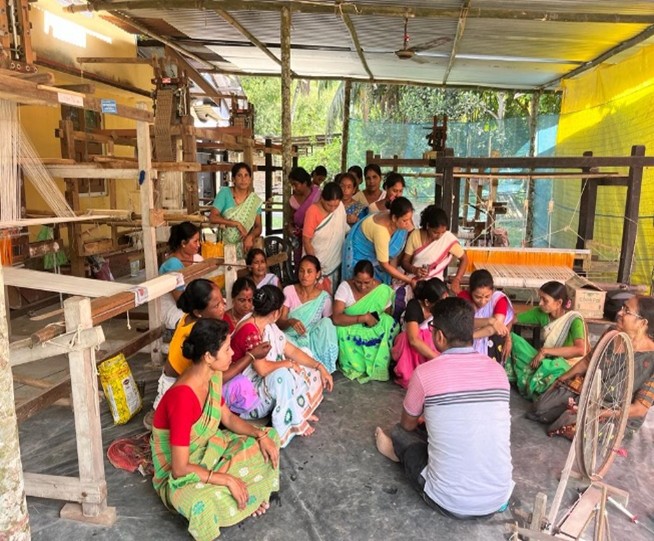
In the weaving communities of Assam, skill and tradition run deep—but opportunity often does not. Across districts like Darrang, many rural women entrepreneurs (RWEs) possess exceptional craftsmanship, yet their enterprises remain limited by a lack of digital access, market awareness, and institutional support.
For women like Sakuntala Das from Paschim Mangaldoi and Hemaprava Kalita from Sipajhar block, weaving is not just a livelihood—it is a legacy. Leading clusters of 30 to 60 women each, they represent a strong network of skilled artisans. However, despite their capabilities, scaling their businesses has remained a challenge.
Their struggles are not rooted in a lack of talent, but in a gap of information and access.
Many of these women are unaware of essential compliances required to formalize and grow their enterprises. Opportunities such as Yarn Banks, Yarn Passbooks, and Handloom Mark certifications are known to them in name, but the processes, documentation, and pathways to access these benefits remain unclear. To procure raw materials like yarn, they often travel long distances, incurring additional costs that reduce their margins.
Equally challenging is the lack of exposure to evolving market demands. While they aspire to innovate and design products aligned with current trends, they lack the guidance and real-time information needed to make those shifts. What they need is not just access—but consistent handholding, mentorship, and a reliable source of information within their own community.
This is where digital empowerment offers a breakthrough.
Through the establishment of Soochnapreneur Business Mitra (SBM) Centres, a new pathway is emerging. These centres are designed to serve as local hubs of information, guidance, and digital services—bridging the gap between rural entrepreneurs and the wider ecosystem of opportunities.
SBMs, trained as digital information entrepreneurs, act as trusted community resource persons. They support RWEs in understanding compliance requirements, completing documentation, accessing government schemes, and building linkages for finance and markets. More importantly, they provide continuous mentoring—helping women make informed decisions and gradually strengthen their enterprises.
For the clusters in Darrang, this model holds transformative potential. With the support of an SBM centre, women like Sakuntala and Hemaprava can move beyond isolated efforts towards building a collective enterprise. Access to timely information, reduced dependency on distant markets, and improved understanding of digital tools can enable them to scale their businesses sustainably.