


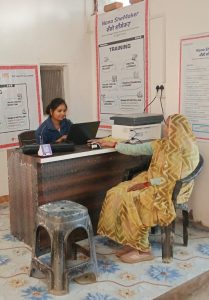
 At her Nano SheMaker digital centre, Girja’s work goes far beyond education; it has become a vital access point for citizen entitlements in her region.
Every week, community members visit her centre seeking help with essential services that were once difficult to access due to distance, lack of awareness, or digital barriers. Girja assists them in applying for government schemes, updating Aadhaar details, linking bank accounts, and accessing benefits such as pensions, scholarships, and ration services. For many elderly residents and women, this is their first direct interaction with formal systems.
She also supports villagers in downloading important documents, filling online forms, and navigating government portals, tasks that would otherwise require long travel to towns. Her ability to patiently guide each individual, explain processes in simple terms, and ensure accuracy has made her centre a trusted hub.
Financial inclusion is another key part of her work. Girja facilitates digital payments, helps open bank accounts, and supports transactions through secure platforms. This has reduced dependency on middlemen and increased transparency for beneficiaries.
Importantly, she doesn’t just provide services, she builds awareness. Through conversations at her tuition centre and digital sessions, she informs people about their rights, available schemes, and how to access them independently over time.
What makes her effort impactful is not just access, but dignity. People no longer feel excluded or dependent, they feel informed, capable, and connected.
In a region where information once traveled slowly, Girja has become a bridge between governance and the grassroots, ensuring that entitlements are not just announced, but truly delivered.